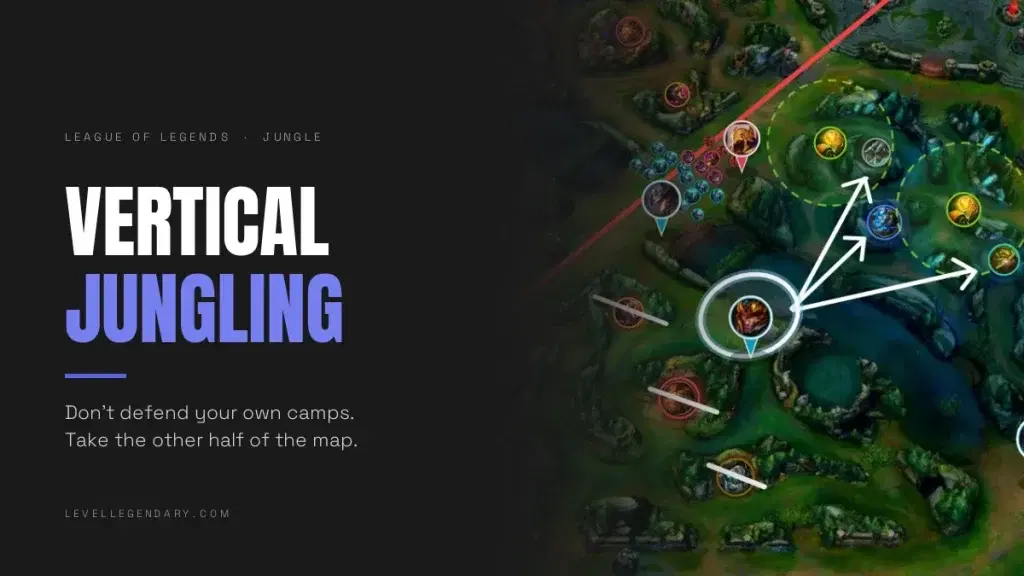
Most junglers who get invaded try to defend their own camps, and that is almost always the losing answer: the winning one is to go and take the other half of the map.
Walking the length of the map to save two camps costs far more than the camps. You arrive late, you lose the tempo that would have paid for your next objective, and you often die on the way if they have lane priority. That is a wasted minute of jungle time, and usually the Grubs or the Dragon that spawned inside it.
One of the most powerful concepts in jungle macro is splitting the map, usually called vertical jungling. Instead of both junglers farming their own side, the map gets divided between them: you control one half, the enemy controls the other. In the simplest version you take your own top-side jungle and theirs as well, while the enemy jungler does the same on the bottom side. Each of you ends up with half of both jungles rather than all of your own.
This is not really about stealing camps. The point is to control where the enemy jungler is allowed to play, and to force them into uncomfortable decisions. It works because jungle resources, lane pressure, vision and objectives are all connected. Control one side and you can make it progressively more dangerous for them while making your own strong side stronger.
What splitting the map actually means
Say the enemy jungler invades your bottom-side jungle early and starts taking camps. You have two options.
The first is to walk the length of the map and defend camps that are already being eaten. That is usually a bad decision. You arrive late, you lose tempo, and you may die on the way if they have lane priority.
The second is to recognise the trade and immediately take something on the opposite side. They are in your bottom jungle, so you go into their top jungle and take theirs. Now neither jungler has full control of their own side, and the map has been divided.
That is the basic shape of it: they take your side, you take their corresponding side, and both junglers end up operating on opposite halves. It can be planned from the first clear or it can emerge naturally after an invade. The difference between good and bad vertical jungling is whether you are simply reacting to being invaded, or using the situation to build a map state you want.
The aim is not to win the enemy jungle by taking everything. It is to end up with a predictable strong side while they get pushed onto the weaker one.
Vertical jungling is far easier to plan on a map than in prose. You can draw your pathing on the Summoner’s Rift map planner and see which half of the map you are really claiming.
Why you would want to split the map
Control. When you own one side you know where your resources are, roughly where the enemy jungler has to be, and which lanes you can realistically help. Jungle tracking gets much easier because their options have shrunk.
Say your bot lane is your strength: an ADC who is ahead, a support with engage, and a mid laner with priority. Rather than farming both sides and hoping something appears, you deliberately build a bot-side stronghold:
- Take your own bot-side camps
- Invade their bot-side camps whenever it is safe
- Ward the entrances
- Play around bot lane rather than drifting
- Take Dragon when the window opens
Now the enemy jungler has a problem. Enter your side and they may have to fight you, your bot lane and your mid laner at once. Avoid it and they concede camps, objectives and pressure. That is the real strength of splitting the map: you are not just taking camps, you are removing their good options.
The goal is to force bad decisions
This is where jungle play stops being about efficient farming. You want the enemy jungler to arrive at moments where every available choice is uncomfortable.
Suppose you control the bottom half, your bot lane is pushing, your mid has priority and Dragon is coming up. Look at what they can actually do:
- Contest their bottom jungle. They are walking into an area where you have vision and your laners rotate first.
- Stay top side. They concede their bottom camps and probably the Dragon.
- Gank top. If you read it, you spend that time on their camps, the Dragon, or bot pressure.
- Recall and reset. You get even longer to take whatever you want.
That is the principle: build a map where the enemy jungler has no comfortable option. Strong junglers do not necessarily kill the enemy jungler over and over. Often the bigger advantage is making them wander around unsure which parts of the map they are allowed to enter.
Split around your strong side
Vertical jungling works best when it is tied to your team’s win condition. If bot is your strongest lane, you are not splitting the map at random. You are making sure your best players sit on the side you control:
Control bot side, protect bot, invade their bot side, deny their resources, hold Dragon, push the enemy jungler away from all of it.
Now flip it. Your top laner is on a champion that snowballs hard with an early lead and your bot lane is weak. The same strategy points the other way:
- Control the top side
- Get your top laner priority
- Invade their top jungle
- Threaten Grubs and top-side objectives
The enemy jungler is then choosing between defending their own jungle and helping their bot lane, and they cannot do both. That is why this is more than a jungle technique. It is how you turn one side of the map into your team’s territory.
Three rules for splitting the map
- Trade sides, never chase. If they are in your bottom jungle, take their top jungle. Crossing the map to defend camps that are already being eaten loses you the camps and the tempo both.
- Split around your strongest lane. The half you keep should be the half your best laner and your mid priority already sit on. Otherwise you are holding a side nobody can help you hold.
- Ward the entrances before you take the camps. The split is only worth something while you know where they are. Vision is what turns half a map into a no-go zone instead of a coinflip.
How the split gets broken
Eventually you want to reunite the map, and the way you do it is lane priority and vision. If your mid and side lane can push first, you enter your jungle together instead of alone. At that point the enemy jungler cannot comfortably invade, because several players can collapse on them.
This is also why vertical jungling is powerful early but fragile. It depends on lane states. A jungler holding half the map without lane support will eventually lose it. A jungler holding half the map while their lanes have priority can turn that whole quadrant into a no-go zone.
The psychological side
There is a psychological element too. Once a jungler has been invaded a few times, they start to fear their own jungle:
- They check bushes before every camp
- They hesitate before starting
- They ping for help they do not need
- They waste time waiting for a teammate
- They abandon camps that were completely safe
That is enormously valuable, because you are applying pressure without being there. They think you could be in their jungle, so they play as though you are. That uncertainty costs them tempo, and jungle tempo is everything.
But my lanes never have priority
Then you are not splitting the map, you are standing in the enemy jungle on your own, and that is how junglers with good intentions end up two levels down. The split is a lane-state play before it is a jungle play.
The version that works without priority is smaller and still pays. Take the trade when they invade you, take the matching camps on the far side, then go back to your own half rather than pushing deeper. You are not building a stronghold in that game, you are refusing to lose the trade, and that is enough. Build the stronghold in the games where a lane actually gives you the first push.
From the coach
The junglers I coach usually know how to clear efficiently already. What changes their games is deciding which half of the map belongs to them before the first camp is dead, because every ward, every gank and every objective after that follows from the answer.
Fronex, Master, jungle and top coach at Level Legendary. See his coach profile.
Vertical jungling is a read you develop faster with feedback. 1-on-1 League of Legends coaching turns one good game of it into a repeatable pattern.
If you want this checked against your own games rather than a diagram, your first session is free: a coach reads your OP.GG and goes through one of your games with you, live, with no card required.