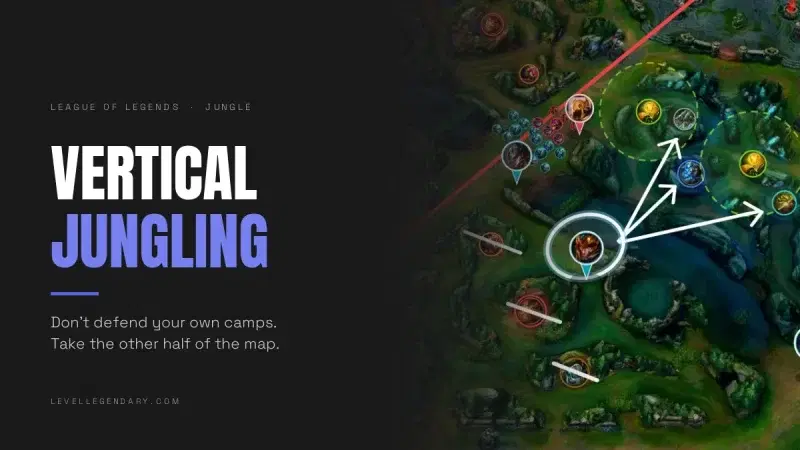

Most junglers pick a route at champion select and never touch it again. They path the standard way, buff, buff, first camp, gank, regardless of what is actually happening in their lanes. The junglers who climb do something different: they treat pathing as a decision that updates constantly, starting from the moment the loading screen appears.
The cost of the fixed route is quiet, which is why it survives so long. You are not throwing games, you are spending your first ten minutes on lanes that did not need you while the lane that could have swung the game gets ganked twice by the jungler who was paying attention. Over a season that is not a few lost games, it is a rank.
What follows is how to build a gameplan before the game starts, how to read your matchups to decide where your attention is worth the most, and how to execute on it once you are in the game.
Step 1: Build your gameplan on the loading screen
Before you take a single step into the jungle, you already have information that should shape your first ten minutes. Look at:
- Your own champion’s power spikes. Are you strong at level 2? Do you need level 3 or your first item to do anything? Are you in a winning jungle matchup, so that invading is on the table? A champion like Kha’Zix wants to gank early and snowball. A champion like Fiddlesticks might prefer to farm to 6 and look for a game-changing ultimate.
- Each lane matchup, not just your own. Look at all five matchups on the map. Ask which lanes are winnable for your team without your help, which are losing and need protection, and which are dead even and could swing either way with a single gank.
- The enemy jungler’s likely path. Based on their champion and your early vision, guess whether they are starting top side or bot side, and whether they are a fast-clearing scaling jungler or an early-game invader.
The goal is not to lock in a rigid route. It is to walk into the game with a hypothesis: I think bot lane is my best gank, because we have crowd control and they have immobile champions. That hypothesis is what you test in the first two minutes.
Step 2: Treat matchups as a resource allocation problem
Once the game starts, your jungle time is the most valuable resource on the map, and every gank or camp is a decision about where that resource goes. Instead of asking which lane you should gank, ask three questions about every lane.
Can this lane win on its own?
If your mid laner is stomping their opponent 1v1, your presence is a bonus rather than a necessity. Spending five minutes babysitting a lane that is already winning is often a worse use of time than helping a lane that is losing, or contesting one that is even. The way to support a winning lane is to countergank and protect the lead, not to farm attention into it.
Is this lane salvageable if it is losing?
Some losing lanes turn around with one well-timed gank. A jungler shows up, gets a kill, and the momentum flips. Others are lost causes in the short term. A laner who is already 0/3 and permanently shoved under turret usually cannot be saved by a single gank, and you risk trading your own tempo for nothing.
Is this an even lane where my gank has outsized value?
Even matchups are usually your best target. A single kill, or even just a burned summoner spell, can tip an even lane decisively, and the laner you helped is now ahead instead of merely not losing.
Run this checklist every recall, not just at the start of the game. Lane states change fast, and a gameplan that made sense at 4 minutes can be outdated by 8.
Step 3: Decide who you are playing for
This is the step most junglers skip, and it is the difference between a farming jungler who occasionally ganks and a jungler who actually carries games. You need to decide which lane, or which player, you are playing the rest of the game around.
Ask yourself:
- Who has the highest ceiling if fed? Some champions scale into game-winning threats with a lead, such as hypercarry ADCs or snowball mid laners like Zed or Akali. Others are useful but capped, like an assassin into a tank comp.
- Who is mechanically capable of using a lead? This matters especially in solo queue. A fed laner who cannot close out a lead, take turrets, or transfer the advantage to the map is not worth continued investment. Watch their first few minutes. Are they taking smart trades, punishing mistakes, using their advantage to push and roam? If so, that is your player.
- Who matches your own win condition? If you are on a jungler that wants the game over by 20 minutes, like Lee Sin or Kha’Zix, invest in whoever else can close fast. On a scaling jungler like Shyvana or Karthus, you may be playing for map control and objectives rather than any single carry.
Once you have picked your win condition, your pathing should reflect it. That does not mean ignoring every other lane. It means that when you have a choice between two roughly equal options, you default toward the lane and the player you decided to build the game around.
Step 4: Play to your strengths, not the correct route
There is a difference between the theoretically optimal path and the path that actually works for you and your champion.
- On a champion with strong early ganks but a weak clear, like Elise or Nidalee, lean into invading and early pressure rather than farming to your first item.
- On a champion that needs items to function, like Karthus or Master Yi, prioritise safe efficient clears and only gank when the opportunity is close to free. You cannot afford to fall behind on farm chasing 50/50 ganks.
- If your mechanical strength is skirmishing and duelling, look for 2v2s, counterganks and small-scale fights rather than pure farming routes, even if a guide would tell you to full clear.
This is where a lot of guides fail junglers. They teach one standard route as if every game and every champion plays the same way. Your gameplan should be built from your champion’s strengths, your own mechanical strengths, and the specific matchups in front of you, not copied from a generic route.
Step 5: Take the opportunities, not just the plan
Your gameplan is a starting hypothesis, not a script. The best junglers constantly scan for openings that override the plan:
- A laner overextends and gets caught out of position. That is a free kill.
- The enemy jungler is spotted on the far side of the map. That is your window to invade, start an objective, gank a lane they cannot help, or set up a dive.
- A lane pushes itself into your favour without you doing anything. That is a free gank waiting to happen, not a reason to path elsewhere.
The skill is holding the gameplan loosely enough to react to the map in real time, while keeping enough direction that you are not wandering and waiting for something to happen. Good pathing is roughly 70 percent plan and 30 percent reaction. Junglers who are all plan get outmanoeuvred. Junglers who are all reaction never build any real map pressure.
A first clear, decided in real time
You loaded in thinking bot was your gank: you have crowd control, they have two immobile champions. That is the hypothesis, and the first clear is where you test it.
You start top side and clear down. At around two minutes your bot lane is shoved to the enemy tower, which is the worst possible state for a gank, and your mid laner has just taken a bad trade and is sitting at half health with the wave coming to him. The hypothesis is dead for now. Do not walk bot anyway because that was the plan.
Read the second piece of information instead. Their jungler started bot side, which means the next camps he wants are the ones you are standing next to. So you finish your clear towards mid, take the scuttle on that side with your mid laner able to walk down and help, and you either get the crab for free or you get a 2v2 with the numbers on your side.
Now the map has changed shape. Your mid is healthy and pushing, their jungler is on the far side, and your bot wave is bouncing back towards you. That is the gank the loading screen promised, arriving three minutes later than planned because you let the map tell you when. The plan was never the route. The plan was the target, and the route was how you waited for it.
If it helps to see the clear rather than read it, sketch it on our map planner: drop both junglers, mark the camps in the order you take them, and the tempo swing stops being abstract.
Three rules for every recall
- Spend your time on even lanes first. A winning lane does not need you and a lane that is 0/3 under tower usually cannot be saved. The even matchup is where one gank changes the result.
- Pick the player, not the lane. By fifteen minutes name the teammate you are playing around: highest ceiling, able to use a lead, matching your own timing. When two options look equal, default to them.
- Re-read the map every recall. Lane states go stale in four minutes. A gameplan built at 4:00 and still being followed at 8:00 is not a plan any more, it is a habit.
Putting it together
A strong pathing gameplan looks like this in practice:
- Before the game, form a hypothesis about your best gank target and the enemy jungler’s likely path.
- In the first clear, confirm or update that hypothesis from what you actually see: wards, lane pushes, enemy jungler sightings.
- By 10 to 15 minutes, commit to a win condition, the lane or player you are playing the rest of the game around.
- Path with that win condition as your default, but stay flexible enough to punish free opportunities as they appear.
- Reassess constantly. Lane states, item power spikes and vision control all shift through the game, and your pathing should shift with them.
Junglers who master this do not just gank more. They gank the right lanes, at the right time, for the right reasons. That is the difference between a jungler who feels impactful every game and one who is along for the ride.
But my team flames me for not ganking
They will, and it is worth understanding what they are actually reacting to. A laner pinging for a gank is rarely asking you to walk into a lost 2v2. They are telling you they are under pressure and cannot see what you are doing about it.
Most of that pressure disappears with information rather than presence. Ping your path when you start it, ping the enemy jungler the moment you see him, and tell a lane once that you are coming after the next camp. A jungler who communicates a plan gets given time. A silent jungler doing exactly the same clear gets flamed for it, and then plays the rest of the game reacting to pings instead of to the map, which is how a good gameplan actually dies.
From the coach
When I review a jungle game, the first question I ask is who the player was trying to help, and most of the time they cannot answer it. A route you can explain beats an optimal one you copied, because you can adjust the first when the game changes and you cannot adjust the second.
Coach Brian, Grandmaster, coach at Level Legendary. See the coach profile.
A guide gives you the framework, but a coach watching your first clears will catch the tempo leaks you cannot see yourself. That is exactly what LoL coaching is for.
If you want your own pathing looked at rather than a general route, your first session is free: a coach reads your OP.GG and goes through one of your games with you, live, with no card required.