Most players position once, at the start of the round, and then watch. Positioning is not a setup you build, it is a reply to the seven other boards in the lobby, and a reply you only give once is usually wrong.
You can lose a fight you were favoured in purely by where you stood. Same units, same items, same level, and the fight is decided before the first attack because your carry was standing where their threat lands.
That is the quiet reason a board that “should have won” keeps taking damage. Nothing on the scoreboard tells you positioning lost it, so most players go on believing they were unlucky.
Scout first, position second
The single biggest gap between a Diamond player and a Gold one is not board strength. It is that the Diamond player looks at the opponent before deciding where anything goes, every round, without being reminded.
Scouting takes about eight seconds. You are looking for three things only: where their main damage is, whether they have anything that jumps your backline, and whether they have moved since last time.
Three rules for positioning
- Scout before every fight, not before every third one. Their board changes constantly. Positioning against last round’s board is the same as not positioning at all.
- Put your carry as far from their threat as the board allows. If their damage sits left, your carry sits right. This one rule wins more fights than any item choice you will make that round.
- Move something every round, even a single hex. Predictable boards get countered by anyone paying attention, and one hex is often the whole difference against a jumper.
A stage 4 fight, played out
You are level eight, your board is finished, and you are about to fight the player who has been first all game. Here is the sequence that decides it, and none of it happens on your own board.
The eight second scout
Open their board before you touch yours. Their carry is bottom left behind two frontline bodies, and they are holding a unit that dives the furthest target from it.
Now you have a real problem to solve rather than a vague preference. Positioning only becomes a skill once you are answering a specific threat instead of arranging your units tidily.
The counter, and its cost
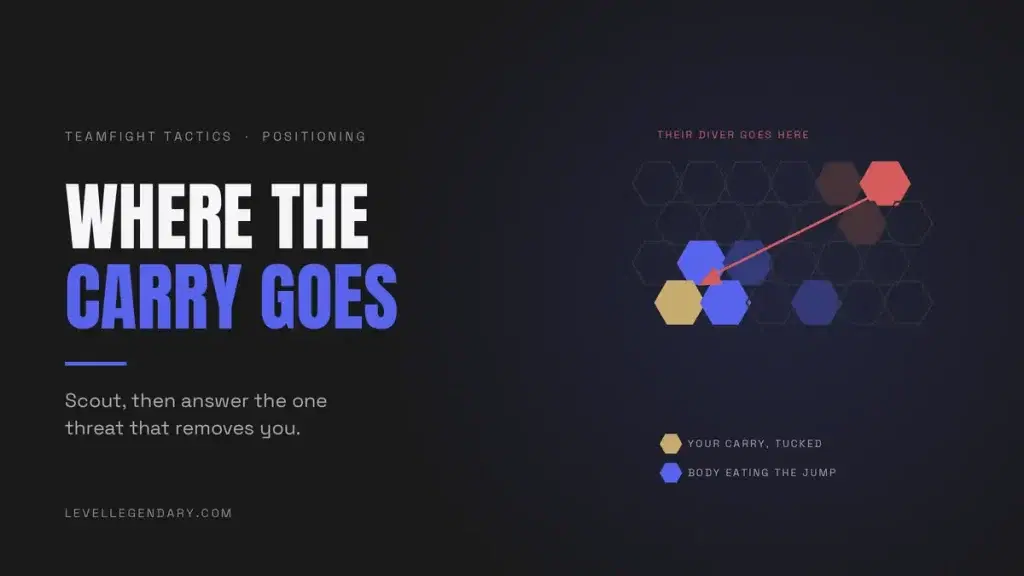
Against a diver, the far corner is the worst place for your carry, not the safest, because that is exactly where it lands. You move your carry off the corner and put a body next to it to eat the jump.
Every counter costs something. Tucking your carry against a diver usually pulls it closer to their frontline, which means less time attacking freely. You accept that, because dying at second two costs more than attacking slightly later.
What you learn from the loss
If you lose anyway, watch where their unit actually landed before you next fight them. Positioning is iterative, and the same opponent comes round again three times a game, which is what makes the eight seconds worth spending.
The four positions worth knowing
You do not need a library of layouts. Four shapes cover almost every board you will face, and the skill is picking between them rather than memorising more.
- Corner. Carry in the far corner, frontline pushed forward. Best against ranged damage that has to walk to you, worst against anything that jumps the furthest target.
- Tucked. Carry one hex off the corner with a body beside it. The default answer to divers, and the position most players never try because it looks wrong.
- Split. Two damage threats in opposite corners so one area of effect cannot catch both. Costs you trait bonuses that want units adjacent, so it is a trade rather than an upgrade.
- Spread. Everything separated by at least one hex against heavy area damage. The right answer far less often than people play it, because it weakens your frontline holding a line.
Pick the shape that answers their strongest threat, then stop. Trying to be safe against all four kinds of board at once produces a layout that is mediocre against every one of them.
“Positioning is basically a coinflip”
Against one specific opponent, sometimes. Across a whole game it is not close to a coinflip, because you fight seven boards repeatedly and the reads compound. A player who scouts is not guessing better, they are guessing less often.
The fair version of the objection is that you cannot counter everything at once. That is true and it is why the priority order matters: protect against the threat that removes your carry first, and accept being slightly worse against everything else.
You are not trying to build a board with no weakness. You are choosing which weakness you can afford this round.
From the coach
When someone tells me their board keeps losing fights it should win, I do not look at their units at all. I ask them to talk me through what the enemy board looked like, and most of the time they cannot, because they never opened it. That is the whole problem, and it is a habit rather than a skill.
Dael Comps, Master tier TFT coach at Level Legendary. See his coach profile.
What to do in your next game
- Scout every single round for one full game. Open the board of whoever you are about to fight before you touch your own. It will feel slow for two games and automatic by the fourth.
- Ask one question before each fight: what removes my carry? Position against that answer and ignore everything else until it is handled.
- Move at least one unit every round. Even when nothing changed, the habit stops you being a fixed target for the players who do scout.
Positioning, itemisation and economy are the three skills that carry across every set, which is why they are worth building now rather than relearning at each rotation. Item slamming is the quickest to fix, the roll or level call is the most punishing to get wrong, and positioning is the one that quietly decides fights you thought you had already won.
If you want a coach to watch you scout and tell you what you are missing, your first session is free: one of your own games, reviewed live with a Master tier coach, and a written action list at the end. No card required, and TFT coaching beyond that is entirely up to you.