Almost nobody actually chooses between slow rolling and fast 8. They play whichever one worked last game, then blame the shop when it does not.
You make this decision once per game, usually somewhere around stage 3-2, and it is worth more than every item decision you make put together. Pick wrong and you either spend forty gold rolling at a level where your unit was never likely to appear, or you sit on a pile of gold while the lobby levels past you and takes your health.
Most of the time, the gap between a top four and a seventh is not the comp. It is whether the plan matched the board.
That matters more than usual this week. Enchanted Wilds arrives on 26 August with patch 18.1, which means for the next few days nobody has a reliable tier list, including the sites publishing them. The roll-or-level decision is one of the few things that still works on day one of a set.
Your carry’s cost picks the plan, not your mood
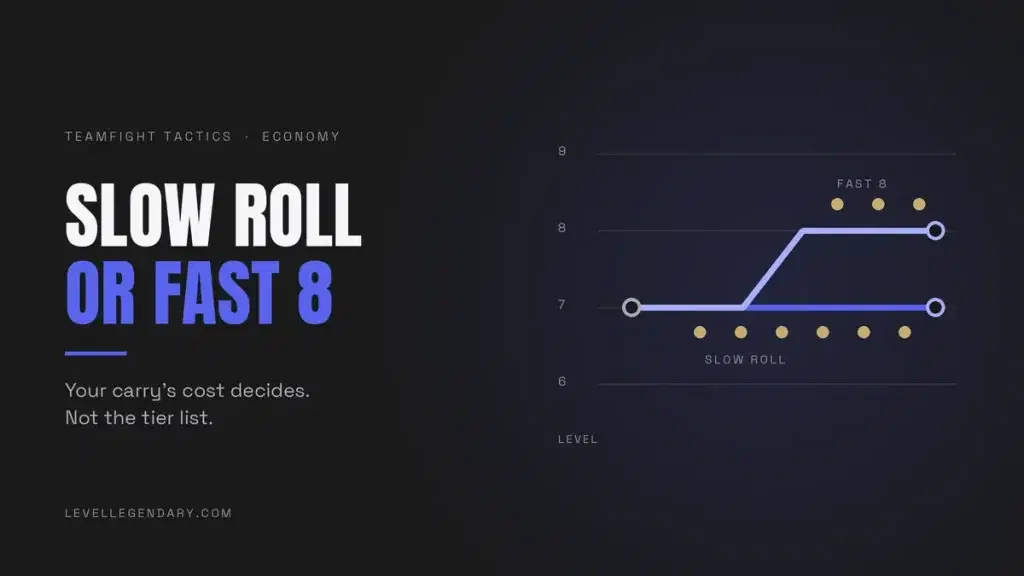
Both plans are simple to describe. Slow rolling means parking at level 6 or 7 and spending only the gold above 50 each round, hunting a 3-star out of a shop that is weighted towards cheaper units. Fast 8 means levelling on curve, banking gold, and doing your rolling once you arrive at 8 where the expensive units are common.
The shop is a probability machine and your level is the dial. In every set so far, the middle levels favour 2 and 3-costs, and level 8 is where 4-costs start showing up in numbers. The odds table sits in your game client and it is worth opening once at the start of a new set, because those numbers do occasionally move.
Which means the unit your board is built around has already made the decision for you. If your damage comes from a 3-star 3-cost, levelling away from 7 actively lowers your odds of finding it. If your damage comes from a 2-star 4-cost, rolling at 6 is paying two gold a spin at a shop that mostly cannot show you the unit.
Three rules for the roll or level call
- The carry’s cost picks the plan. A 3-star 3-cost carry means slow roll at 7. A 2-star 4-cost carry means bank gold and level to 8. Decide which one your items are already sitting on before you spend anything.
- Slow rolling means rolling down to 50 and stopping. Dip below 50 and you have broken interest, which is not slow rolling, it is panicking. The one exception is being a round away from dying, where health is worth more than gold.
- Level on a timer, roll on a threshold. Reaching 8 with 10 gold loses to reaching 8 two rounds later with 30. If you cannot arrive and still have gold to roll, you were never really on the fast 8 plan.
Wisps change the maths, so read them as a question
Set 18 adds Wisps: single-use buys that appear in the rightmost shop slot on every other shop, one per round, getting stronger as the game goes on. Some give combat power, some hand you experience or gold outright, and some are deliberately high risk.
The ones that sell experience or gold are the ones that matter here, because they make the shop a place you can buy tempo. A Wisp that sells experience is a fast 8 accelerant. A Wisp that sells gold is a slow roll enabler.
Nobody knows the pricing curve yet, so treat each one as a question rather than a purchase: does this buy the plan I already picked, or is it tempting me into the other one? A player who slow rolls all game and then buys three experience Wisps has quietly paid for both plans and committed to neither.
A stage 3-2 decision, played out
What the board is telling you
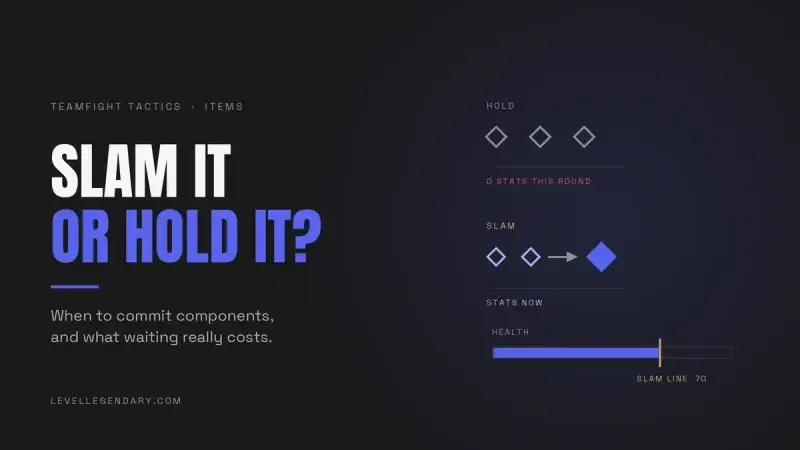
Stage 3-2. You are level 6, on 52 gold and 70 health, riding a modest win streak. Your item holder is a 3-cost you have two copies of, and the items on it are ones that unit genuinely wants rather than ones you happened to build.
That last detail is the actual signal. Items are the part of your board you cannot re-roll. When your completed items fit a 3-cost, the cheapest route to a strong board is finding six more copies of a unit the shop is already inclined to show you.
The two gold reads
Before you commit, check two numbers that have nothing to do with your own board.
First, contest. Scroll the other seven boards and count how many players are holding your unit. One is survivable. Two or more and the copies you need are already gone, and the plan should change even though nothing about your own board changed.
Second, health. At 70 you can afford to lose three or four rounds while you look. At 40 you cannot, and a slow roll that would have worked at full health becomes a fifth place at low health, because health is the currency that actually buys you the extra rounds.
Committing, and the round after
You commit: roll down to 50 each round and stop at 50, every round, without negotiating with yourself. Interest keeps paying, the streak keeps paying, and you get a fresh shop each round for free.
Now the part most players skip. Decide in advance what a failed slow roll looks like, and make it a number: two full rounds of rolling with no upgrade and health under 50 means the plan is dead. When you hit that line, stop, bank, and level towards the 4-cost board instead of rolling one more time because this one feels due. It does not feel due. The shop has no memory.
But the tier list says fast 8 is stronger right now
Tier lists rank comps, not situations. Fast 8 tends to sit at the top because the strongest boards in most sets are 4-cost boards, which is a fact about the ceiling rather than a fact about your game. What decides your placement is whether the shop can hand you the units your items are already on.
There is a version of this that is fair: if you slow roll every game because it feels safe, you are capping yourself, and you will collect a lot of fourths. But the player who forces fast 8 into a board built on a 3-cost is making exactly the same mistake in the other direction. Both picked the plan before reading the board.
In the first week of a set the point is sharper still, because the tier list is being assembled from games played by people who do not know the set yet either. Reading your own board is not a fallback in that week. It is the only source that is actually current.
From the coach
When a player tells me they slow rolled and missed, I ask what they would have been left with if they missed, because that number should have been part of the plan before the first reroll. Nine times out of ten there was no number, which means it was never a plan, it was a feeling.
Dael Comps, Master, TFT coach at Level Legendary. See his coach profile.
What to do in your next game
- At stage 3, say which unit you are building around and what it costs. Out loud, or typed into chat if that is easier. If you cannot name the unit, you do not have a plan yet and you should not be spending gold.
- Write down the number you stop rolling at before you start. Fifty if you are healthy. Lower only if you are one round from dying, and only for as many rounds as your health actually covers.
Do that for a set of ten games and the pattern shows up quickly: your good games look the same as they did, and your bad games get much cheaper, because you stop paying forty gold to find out something the board told you at stage 3. That gap is most of what separates a Gold player from a Master one, and it survives every set change, including the one landing tomorrow. If you would rather work on it with someone watching, that is what our TFT coaching is for.
If you want the call made on your own boards rather than an example one, your first session is free: a coach goes through one of your games with you, live, with no card required.