Holding components for the perfect item is the most expensive habit in TFT. The player sitting on five components at stage 4 did not lose there. They lost at stage 2, and nobody told them.
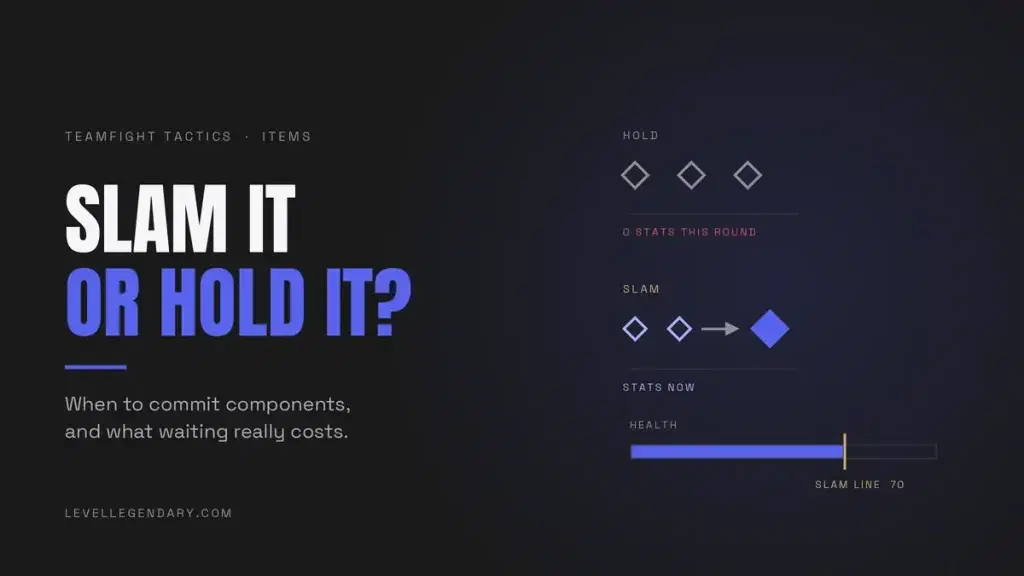
An unslammed component is zero stats. A bow in your bench does nothing, blocks nothing, and kills nothing, and you take a full round of damage for the privilege of keeping your options open.
Do that four rounds in a row while the lobby slams and you arrive at the mid game twenty health down with the same board you would have had anyway. Health is the resource you are actually spending, and it is the only one you cannot buy back.
What holding a component really costs
Every item decision in this game is a trade between the fight in front of you and the board you want later. Players are taught the later board matters more, so they optimise for it and quietly lose the eight fights in between.
The correct frame is not “is this the best item for my carry”. It is “will the stats I gain this round be worth more than the flexibility I give up”. Below about 70 health, that answer is almost always yes.
Three rules for slamming
- Slam on health, not on plan. Under roughly 70 health, slam anything playable. Under 50, slam everything you can. A theoretical item on a dead board is worth nothing.
- Tank items are almost never a mistake. A frontline item goes on whichever body you are playing this round and keeps working on the next one. Defensive slams are the cheapest way to stop bleeding.
- Only hold when you are winning and the component is flexible. If you are healthy, streaking, and the piece fits three different carries, holding is a real option. Those three conditions together, not any one of them.
A stage 2 decision, played out
You come out of the opening rounds with three components and no clear carry. This is the exact moment most players freeze, so here is how the decision actually runs.
Read the board before the bench
Look at what is already on your board rather than what you hope to hit. If your strongest unit is a frontline body and you are holding a defensive component, the answer is in front of you.
The mistake here is planning around a carry you do not own. A carry you have not hit is a wish, and you cannot put items on a wish. Slam for the board you have, not the board you are hoping for.
Check the health bar, then commit
At full health after a win streak, holding two components is defensible for a round or two while the game clarifies. Coming off a loss streak at 60 health, it is not a decision at all: build the strongest thing available and stabilise.
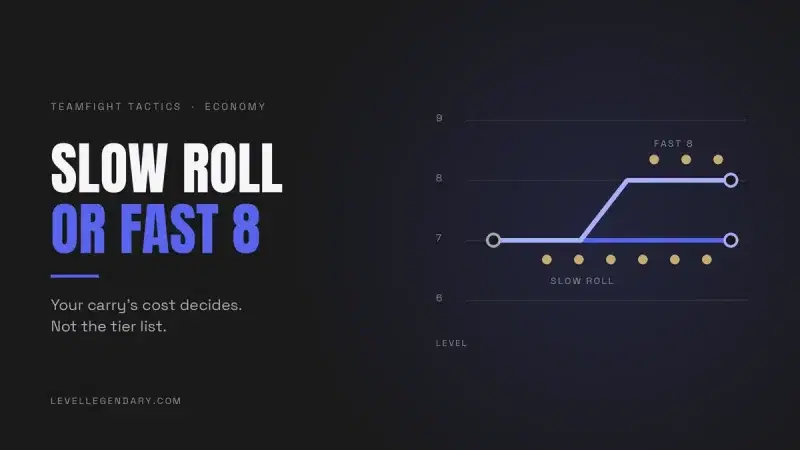
Losing on purpose to build economy is a real strategy, and it stops being one the moment you cannot afford the health. That is the same accounting that decides whether you slow roll or push levels, run on the same currency.
The round after
Once slammed, stop relitigating it. Players lose more games rebuilding around a regretted item than they ever lost to the item itself. If it turns out imperfect later, that is a cost you already priced in when you needed the stats.
Which components are safe to commit
Not every slam carries the same risk, and sorting them once removes most of the agonising. Think of your components in three tiers of regret.
- Almost always safe: defensive items. They go on whichever body is holding your line and stay useful when that body is replaced. Very few boards are made worse by a tank item existing.
- Usually safe: generalist damage items. Anything that helps any carry rather than one specific carry. If three of your plausible directions all want it, you are not really committing to anything.
- Worth a pause: the highly specific. Items that only make sense on one unit type. These are the ones to hold when healthy, and the ones to slam anyway when you are not.
Notice that the tiers describe the item, not your plan. Sorting by how many futures a component fits is the whole decision, and it takes a second once you have done it a few times.
“But I will brick my carry’s best in slot”
Sometimes you will, and it matters far less than it feels like it does. The gap between a best in slot item and a reasonable substitute is usually a few percent of output. The gap between having an item and having a component is all of it.
The honest version of the worry is that slamming early removes a pivot you might have wanted. True, but count how often that pivot actually arrives. In most lobbies you commit to a direction by stage 4 regardless, and the flexibility you protected was never spent.
Pivots are paid for with health, and holding components is you pre-paying for a pivot you will probably never take.
From the coach
Nearly every player I coach who is stuck below Diamond holds components too long, and they all give the same reason: they are waiting to see what they hit. I ask them what their health was when they finally slammed, and the number is always low enough to answer the question for them.
Dael Comps, Master tier TFT coach at Level Legendary. See his coach profile.
What to do in your next game
- Set a slam line at 70 health and hold yourself to it. Below it, the next playable item goes down that round, no deliberation.
- Slam every defensive component you pick up before stage 3. For one week, no exceptions. Notice how much less health you lose in the rounds you used to write off.
- Write down the games you genuinely regretted a slam. Most players find it is one in ten, against four or five games a night saved by stabilising early.
Itemisation is the fastest of the three core TFT skills to fix, because it costs you nothing but a decision rule. Economy and positioning both take practice; slamming just takes permission.
If you want someone to look at where your health actually goes, your first session is free: a Master tier coach goes through one of your games with you, live, and you leave with a written action list. No card required. Full TFT coaching is available after that if you want it.