A freeze in mid lane is not a defensive shell. It is a trap you build, and then choose the moment to spring. Most players learn the first half and never learn the second, so they hold a freeze until it collapses on its own and wonder what it bought them.
A freeze you never cash in is worse than no freeze at all. You held the wave, denied a few minions, and paid for it with every roam window you sat through and every plate you did not touch.
Meanwhile the enemy mid recalled on your freeze, came back with an item, and walked into a lane that no longer threatens them. The freeze was the setup. If you never make the play, you spent four minutes setting up nothing.
Why mid lane freezes are their own skill
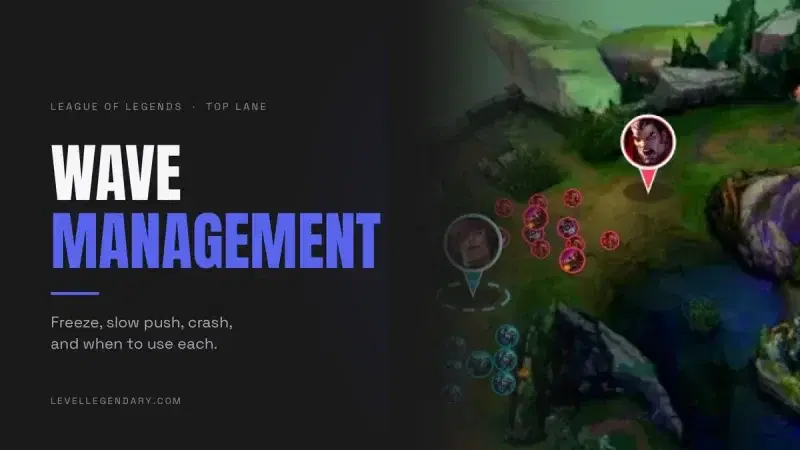
The wave states themselves work the same everywhere, and if you want the mechanics of building one from scratch, the top lane version covers freezing, slow pushing and crashing in detail. Mid lane changes what those states are worth, in three ways.
The lane is short, so a freeze sits close to both junglers rather than tucked away in a corner. It decays faster because the distance between towers is small and one bounced wave resets everything. And every second you spend holding it is a second you are not roaming, which is the one resource a mid laner has that a top laner mostly does not.
That is what makes it an offensive skill in mid rather than a survival one. You are not hiding behind a freeze, you are choosing to stay in a lane you could have left, which only pays if something happens at the end of it.
Three rules for freezing in mid
- Only freeze if you want them standing there. A freeze pulls the enemy mid forward, into your half, away from their tower. If that is not a position you plan to punish, you have built a trap for nobody.
- Name the break before you start. “I break this when my jungler shows bottom side” or “I break this at 9:30 for the wave to crash before drake”. A freeze without an exit condition ends when the enemy decides, not when you do.
- Give up the freeze the moment a roam is worth more. Two plates and a kill bottom beat four denied minions, every time. Freezing is a tool for the games where leaving lane is not the better play, not a replacement for knowing the difference.
Turning a freeze into a kill
Here is the whole sequence with a jungler involved, which is where freezes pay best. You are even in CS, level six, and your jungler is clearing your bottom side quadrant.
Build it just outside your tower
Let the wave push toward you, then hold it by killing only what you must. You want their caster minions alive and your own count low, with the wave settling roughly outside your tower range. The enemy has to walk to your side of the river to farm at all.
Ward before you commit, not after. A freeze is a stationary position in a short lane, which is the exact shape their jungler is looking for, so this is the one habit that decides whether the trap catches them or you. That is a laner’s job, not your support’s.
Let it starve them, and watch the health bar
Hold it for two waves. They will take last hits at range, miss several, and slowly drop health because every minion they walk up for is a trade you get to decline or accept on your terms.
The kill window opens when their health and your cooldowns cross, not when you get bored. You are waiting for the moment they are low enough that your all-in is lethal, or greedy enough to stand too far forward with your jungler nearby.
Spring it
When your jungler is one camp away, break the freeze yourself by shoving one wave into them. The wave crashes, the enemy is pinned under their own tower with no minions of their own, and they have nowhere to walk. That is the moment your jungler arrives.
The gank works because you removed their escape earlier, not because the jungler pathed well. Junglers plan routes around lanes that create these openings, which is why a mid laner who freezes on purpose gets ganked for far more often than one who does not.
How to break a freeze cleanly
Breaking is the half nobody drills, and doing it badly hands the lane back. There are only three clean exits.
- Shove it in. Kill the wave fast so it crashes into their tower. Use this when you want to recall, roam, or set up a gank. It is the only break that buys you time on the map.
- Let it go. Stop last hitting and walk away. The wave rolls toward them and you concede the lane state for a few waves. Use it when you are behind and want the wave near their tower so you can farm safely under yours later.
- Trade it away. Take a fight while the wave is still frozen, win it, and the freeze breaks itself as minions die. This is the strongest break and the one that needs your cooldowns up.
What kills people is breaking by accident: over-last-hitting, shoving half a wave, then standing in a lane that is neither frozen nor crashed. That state has no plan attached to it, and it is where most mid laners die.
“Mid lane is too short to freeze”
Short lanes make freezes harder to hold, not less valuable. They are worth more precisely because they decay fast: a freeze the enemy cannot simply wait out is one they have to walk into, and walking in is the whole point.
The stronger version of the objection is that your jungler never comes, so the trap never springs. Sometimes true, and it is why rule one exists. If nobody is coming, freeze only when you can punish alone, which means a level lead, a cooldown advantage, or an all-in you know wins. Otherwise shove and take the map.
A freeze with no follow-up is a decision to do nothing, slowly. That is a real choice in a losing lane, and a waste of four minutes in an even one.
From the coach
When a mid laner tells me they froze the wave, my first question is what they were waiting for. Half of them cannot answer, which means they were not freezing, they were just failing to push. A freeze is a plan with a timer on it, and if you cannot say the timer out loud you do not have one.
TBR37, Challenger mid and ADC coach at Level Legendary, ex-head coach at League Unleashed. See his coach profile.
What to do in your next game
- Set one deliberate freeze per game and say the break condition out loud. Out loud matters. “I break this when my jungler shows top” is a plan; a vague intention is not.
- Ward the river entrance before you settle into it. Every time, no exceptions. A freeze without vision is a gank you set up for the other team.
- Judge it on what you cashed in, not on your CS. A freeze that ended in a kill, a plate, or a free recall worked. One that just ended was practice.
Freezing is where lane control stops being defensive and starts generating kills, and it is one of the fastest habits to fix because it costs nothing mechanical. This is the kind of decision layer that League of Legends coaching works on first, because a player who freezes with intent gets more out of the same champion pool immediately. Plenty of stalled climbs are one habit like this away, which is the whole argument for LoL coaching over another hundred solo queue games.
If you want a coach to watch where your waves were sitting when your last three deaths happened, your first session is free: a Challenger tier coach goes through one of your own games with you, live, and you leave with a written action list. No card required.