A counter matchup is not lost in champion select. It is lost in the first three waves, by the player who trades as if the lane were even. The pick decides who is favoured. What you do before level three decides whether that favour turns into a kill.
The cost of playing a losing matchup badly is not the lane, it is the game. A death at four minutes in a bad matchup is a lost plate, a lost wave, a lost level, and a jungler who now has to babysit you instead of playing the map.
You do not lose one fight, you lose the right to be left alone. The counter pick was designed to take that from you, and most players hand it over by trying to prove the counter does not apply to them.
What a counter actually does
Being countered means one of three things, and they need different answers. Either the enemy wins every trade at the same level, or they have a window where they win and you have a window where you win, or they simply outscale and the lane is a countdown.
Most players treat all three as the first one and play scared for twenty minutes. Work out which of the three you are in before the first wave arrives. A lane that is only bad from two to six is not a bad lane; it is a lane with a four-minute problem.
The honest version of the first case is rarer than the ladder believes. Genuine “loses every trade” matchups exist, but far more lanes are the second kind, where the opponent’s strong windows are obvious and yours are the bits in between.
Three rules for surviving a counter
- Give up the first two levels on purpose. Do not contest the first wave. Take what you can from range, let them push, and reach level three with full health. The lane you were worried about is mostly a level one and two lane.
- Freeze, never fight for the wave. A wave held just outside your tower makes their counter irrelevant, because they cannot trade without walking into your side of the map. The wave is your bodyguard. Keep it near you.
- Decide your leave trigger before the game starts. One death, a lost plate, or a specific minute mark. When it fires you stop laning and start playing the map. Write it down if you have to.
The first six minutes, wave by wave
Take a top lane where the enemy has a clear early advantage: a long-range poke or a champion whose level two is a kill threat. The same shape applies to any lane; only the timings move.
Waves one and two: refuse the trade you were offered
Arrive on time, stand where you can take last hits without being hit, and let the first wave come to you. If they push, that is what you want. Do not walk up for a minion that costs you a third of your health, because a lost minion is worth twenty gold and a lost trade is worth the lane.
They will hit level two first. Expect it, and be far enough back that it changes nothing. Most early deaths in a counter matchup are not outplays, they are one step too far forward at the exact moment the enemy became stronger.
Waves three and four: build the freeze
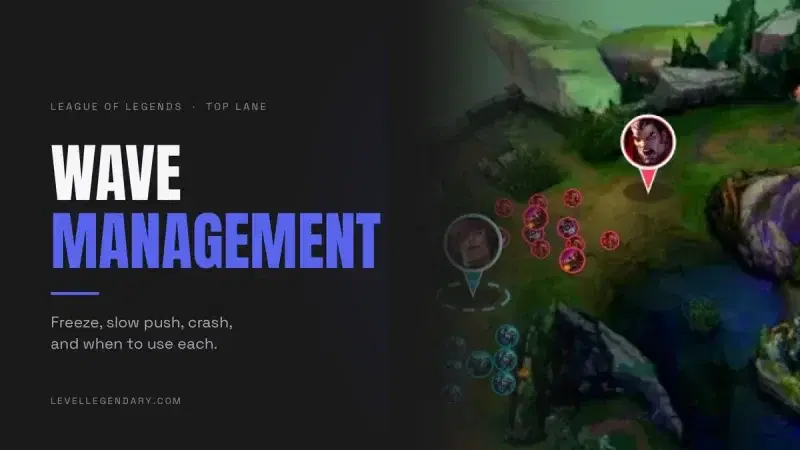
Now they have pushed, and a big wave is sitting outside your tower. Do not let it crash. Thin it so that three or four of their minions survive against none of yours, and hold it there. The mechanics of a top lane freeze are the same whether you are winning or losing, but here the reason changes: you are not freezing to deny farm, you are freezing to make trading impossible for them.
Standing beside a frozen wave, close to your tower, the counter has nowhere to go. To hit you they walk past minions and away from their jungler, and every second they spend near your tower is a second they are on the wrong side of the map. You have turned their lead into a decision they have to keep making.
Waves five and six: check which lane you are actually in
By now you have levels, an item component, and a wave that is exactly where you want it. Ask the question from earlier. Are they still winning every trade, or was the danger a two-level window that has closed? If it has closed, the lane is even and you can play it. If it has not, you keep freezing, take the farm the wave gives you, and let the rest of the map decide the game.
Either way, ward the river side of your lane once you have the freeze, because a frozen wave near your tower is where the enemy jungler expects to find a dive.
When to leave the lane entirely
Some lanes are lost, and pretending otherwise is expensive. If your leave trigger fires, your lane is no longer the place your gold comes from. Shove a wave when they are gone, then go where the map is winnable: an objective, a roam, a fight in another lane.
Losing a lane is fine. Losing a lane and refusing to leave it is how the game ends. The player who accepts a small deficit and turns up elsewhere wins more games than the player who stays and tries to solve the lane on principle.
“I should just play safe and farm”
Playing safe is the right instinct and the wrong plan. Safe without a wave in the right place is not safe, it is slow. You farm under tower, miss minions to the tower’s damage, fall behind in gold anyway, and get dived because the wave is crashing on you every ninety seconds.
The difference between surviving and merely hiding is where the wave is. Safe is a wave frozen outside your tower and you standing beside it. Hiding is a wave crashing into your tower and you standing behind it. They look similar from the lobby and play completely differently.
The other honest objection is that some counters are so strong that the freeze never gets built, because they shove and dive before wave three. That is real for a handful of matchups, and the answer to those is in the draft, not the lane. If the same pick keeps doing it to you, that is a champion pool problem rather than a laning one, and it is the kind of thing LoL coaching settles in one session by looking at your last ten games against it.
From the coach
Nearly every counter matchup I review was lost between ninety seconds and three minutes. The player knew it was a bad lane, walked up for a minion at level one anyway, took the trade, and spent the rest of the game trying to earn it back. The fix is not mechanical. It is deciding, before the minions spawn, that the first two levels belong to your opponent and the next twelve belong to you.
Fronex, Master, jungle and top lane coach at Level Legendary. See his coach profile.
What to do this week
- Before each game, name which of the three counter types you are in. Every trade, a window, or a countdown. Say it out loud in champion select.
- Play two losing matchups and take zero trades before level three. Not “fewer”. None. See how much health you arrive with and how different the lane feels at wave four.
- Set one leave trigger and honour it. One death or one lost plate. When it fires, you leave, and you check afterwards whether the game went better for it.
If a specific matchup keeps beating you, that is one of the things League of Legends coaching fixes fastest, because a coach can watch the first three minutes of your replay and tell you exactly which step forward cost you the lane. It is also the single most common leak in the Diamond players who arrive with a matchup they refuse to respect.
Bring your worst matchup to a free first session: a Master or Challenger coach goes through one of your own games with you, live, and you leave with a written plan for the next time you see that pick. No card required.