Rewatching the game you just lost is not a VOD review. It is a second serving of tilt at better resolution. A real review is a search with a target, and most players have never been told what the target is.
The cost of skipping reviews is that you lose the same game for months. The same death at the same minute, the same “how did he find me” gank, replayed across hundreds of matches because nothing ever flagged it as a pattern.
If one repeated mistake costs you two extra losses a week, that is roughly 40 LP a week donated to the same lesson. More ranked games will not refund it, because the queue punishes the mistake without ever naming it.
What a coach looks at first
A coach reviewing your game is not watching your outplays. They are reading a handful of cheap signals that predict rank faster than any highlight: where the wave was when you died, what the minimap showed twenty seconds before each death, and whether your recalls bought items or just safety.
None of those need a coach’s eyes. They need a method, and the discipline to point the camera at the boring parts.
- Review wins too, not just losses. Losses are noisy and tilt rewrites your memory of them. A win hides the exact same mistakes, unpunished, and you will watch it calmly enough to actually see them.
- Watch for one thing per pass. Deaths on the first pass, minimap on the second. Watching for everything at once is how you end up watching the fights again and calling it study.
- Ask “what did I know”, not “what happened”. At every death, rewind twenty seconds and read the minimap. If the gank was on screen and you stayed, the mistake was made before the fight started.
The 20-minute self-review
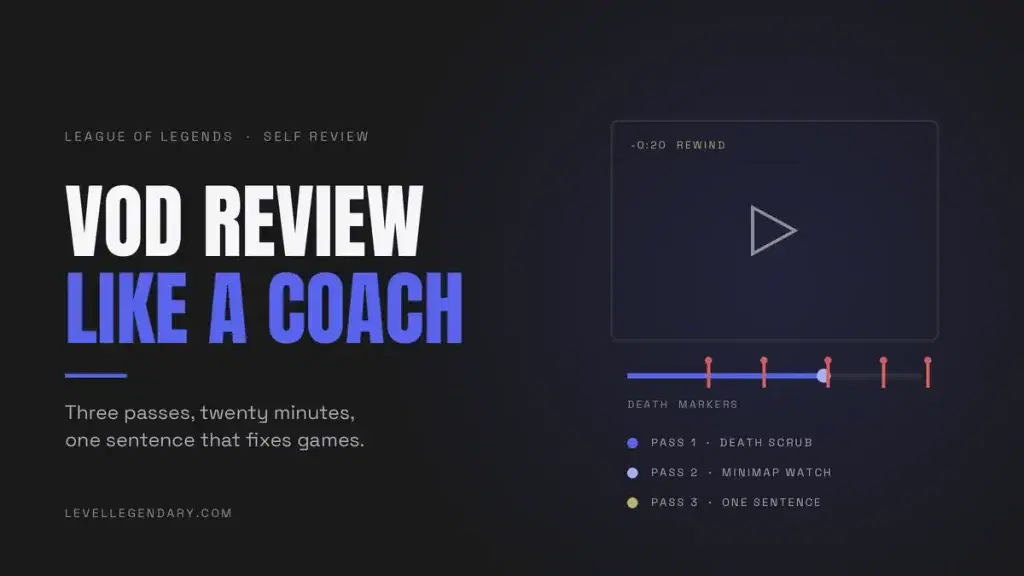
Take your most recent ranked game, win or lose, and run it through three passes. You are not rewatching the game, you are interrogating it. Say you went 4/6 on a mid laner in a 31-minute loss: here is how that review actually goes.
Pass one: the death scrub (8 minutes)
Jump the timeline from death to death and ignore everything in between. For each one, rewind twenty seconds and freeze. Read three things: the minimap, the wave, and your health bar before the fight was ever offered.
Grade the death, do not relive it. Was the enemy jungler missing from the map for fifteen seconds while you pushed past river? That death belongs to the push, not the gank. Died in a side lane with no ward covering the only path to you? That one was a positioning death booked in advance.
Pass two: the minimap watch (8 minutes)
Now watch the same game at 2x speed looking only at the minimap, ideally with the fog of war from your team’s side. Every time you see yourself standing still with no wave to catch and no ward going down, that is dead time.
Count the dead time. In most games below Diamond there are four to six full minutes of it, and it is the cheapest LP you will ever recover, because filling it asks nothing of your mechanics. Where that time should have gone is a rotation question, and the roam windows are learnable.
Pass three: one sentence (4 minutes)
Write a single sentence naming the one pattern that showed up most: “I die pushing past river with the jungler missing.” Not three things. One. Pin it where you can see it and play your next five games against that sentence only.
Then stop. A twenty-minute review that produces one sentence beats a two-hour review that produces a mood.
Set the replay up so the review is honest
The replay client ships with the two settings that make this work, and almost nobody touches them. Turn on your team’s fog of war, so you judge decisions on what was knowable rather than on spectator knowledge. Then learn two keys: the death jump on the timeline, and 2x speed for the minimap pass.
Review on a different day from the game if you can, and never review more than two games in a sitting. The point is a diagnosis, not a punishment, and the quality of your attention drops fast once it starts feeling like the second one.
One honest game a week beats seven guilty skims. The players who make this stick treat it like a fixed appointment: same day, same twenty minutes, one sentence out the other end.
“I already know what I did wrong”
You know how the game felt, which is not the same thing. Memory keeps the two deaths everyone typed about and deletes the quiet minutes where the game was actually decided. The VOD has no feelings about you. That is the entire point of watching it.
The honest version of the objection is that self-review has a ceiling, and it is real. Alone, you can catch the four visible things: deaths with no vision, waves abandoned mid-lane, empty recalls, dead time on the minimap. What you cannot catch are the two invisible ones: habits you do not know are choices, and the plays you never generated at all. No amount of rewatching shows you an option you did not know existed. That second category is what League of Legends coaching is actually for, and it is why players who review diligently still plateau.
From the coach
The first VOD a player sends me is never the game they think it is: they apologise for the two deaths everyone remembers and skip the eight quiet minutes where the game was actually lost. Most of coaching is teaching you where to point the camera.
TBR37, Challenger mid and ADC coach at Level Legendary, ex-head coach at League Unleashed. See his coach profile.
What to do after your next game
- Run the three passes on one game this week. Deaths, then minimap, then the one sentence. Twenty minutes, timer on, no full rewatch.
- Play five games against your sentence. Judge them only on whether the named pattern showed up again, not on whether you won.
- Re-review after those five. If the same sentence comes out again, the pattern is not a knowledge gap you can see, and it is time to borrow better eyes.
This habit alone separates players who climb from players who just play, and it is the first thing to fix in most stalled climbs. It is also exactly how LoL coaching works from the coach’s side of the screen, just with a decade more pattern recognition behind the pause button.
If you want to skip straight to the parts you cannot see yourself, your first session is free: a Challenger tier coach goes through one of your games with you, live, and you leave with a written action list. No card required.