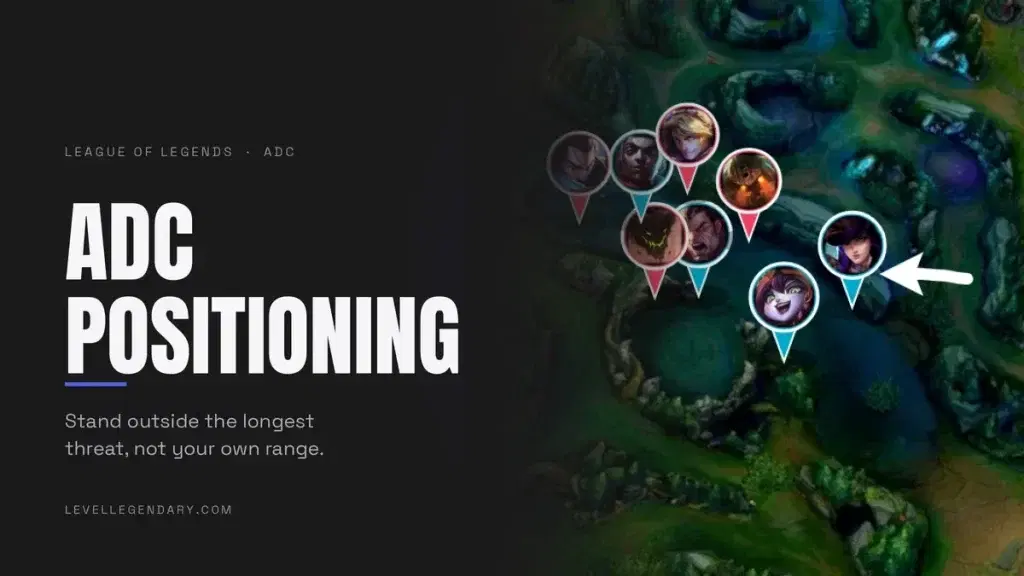
No ADC has ever lost a game by standing too far back. They lose games by standing in the right place for one second too long.
Your death is the most expensive one on the map. You carry the most gold and the most sustained damage, and when you go down eight seconds into a fight, your team is not fighting four against five. They are fighting without the reason the fight was taken.
Two early deaths a game, and the item lead you spent twenty minutes building is working for the enemy team, not yours.
You are measuring your position against the wrong thing
Ask an ADC why they were standing where they were standing, and the answer is almost always about their own range. I was at max auto range. I was behind my support. I was in the back.
None of those are positions. They are descriptions of where you happened to be.
Your position is decided by one question: what is the longest thing on their team that can reach me, and am I outside it? Not their ADC. The engage. A hook, a jump, a flash-taunt, an ultimate with a two-screen cast range. If you cannot name that ability before the fight starts, you are not positioning. You are standing somewhere and hoping.
This is why good ADCs look passive for the first few seconds and then suddenly appear to be everywhere. They are not playing scared. They are waiting for the one ability that kills them to be spent on somebody else.
Three rules for every teamfight
- Position off their longest threat, not off their ADC. Name the ability that reaches furthest into your team, and stand outside it. If you cannot name it in champion select, look it up before you queue again.
- The first three seconds are not yours. Damage you deal at second one is worth less than damage you are alive to deal at second ten. Let their engage commit somewhere else before you throw an auto.
- Attack from the side, never the front. Walk wide and come in from an angle where you are the second closest target. Same range, same damage, a completely different chance of surviving the fight.
A dragon fight, second by second
Dragon in thirty seconds. Your team holds the pit side of the bottom river and the enemy holds the wall. You are on a two-item Caitlyn against a Malphite, a Nautilus and a Yasuo.
Before the fight: name the threat
The longest threat is not the Nautilus hook. It is the Malphite ultimate, which crosses more ground than anything else in the fight and does not care about your positioning once it is airborne.
So the fight has a rule before it starts: stand where a Malphite arriving does not also catch your mid laner and your support. That usually means giving up the tidy grouped formation everyone defaults to, and standing wide, alone, on the far side of your own team, further from the pit than feels correct.
Seconds one to nine: the hook lands
The Nautilus hooks your support. Everything in you wants to auto the hooked target. Do not.
The Malphite is holding his ultimate for the moment your team clumps to peel, which is exactly what happens when an ADC steps forward to punish a hook. Take the free autos on the Nautilus if he is in range, and hold your ground.
Second ten: the ultimate is spent
The Malphite uses his ultimate on your top laner, because your top laner walked in. Now the fight is yours. You have your entire damage output, and they have spent the thing that erases you. Walk in from the wing, not through the middle, and attack whatever is closest rather than hunting their carry.
Notice what decided that fight. Not your mechanics, and not your build. You did nothing for ten seconds and then did everything, which is what ADC positioning is when it works. Objective fights hinge on this more than any other kind, which is why they run alongside objective prioritisation: the team that wins the fight is usually the one whose carry was still alive to take it.
But if I stand that far back I do no damage
Teamfight damage is not what you deal in the first two seconds. It is your damage per second multiplied by the seconds you are alive. A carry who deals nothing for four seconds and then attacks for twelve beats a carry who attacks for three and dies, and it is not close.
Check it yourself: open a game where you died early in a fight your team lost, and compare your damage against the enemy ADC’s. On similar items it will usually be a third of theirs, because they were on the field for the whole fight and you were not.
There is a real version of this problem, and it is different: standing back and never coming in at all. Waiting is a decision with an end point. When their engage is spent, you have to walk forward, and an ADC who never takes that step loses fights just as reliably as one who steps too early.
From the coach
When a player tells me they died because their team did not peel, I ask them to name the ability that killed them and when it came off cooldown. Nine times out of ten they cannot, and that is the actual problem: they were not positioning against anything in particular, so no amount of peeling was going to save them.
Coach Julian, Master, ADC, jungle and support coach at Level Legendary. See his coach profile.
What to do in your next game
- In champion select, name the enemy ability with the longest reach. Out loud, and write it down if you have to. That is the champion you are positioning against for the whole game, not the enemy ADC.
- In every teamfight, count to three before you attack anything. It will feel like throwing damage away. Check the damage chart afterwards and see whether it was.
Players who do this for a handful of games usually find the same thing: they die less, they deal more, and the fights they used to lose in four seconds now last long enough for their items to matter, which is the same gap behind most stalled accounts.
Positioning habits are hard to self-diagnose mid-fight, which is where League of Legends coaching earns its keep: someone else watches the fight so you can watch yourself.
If you want to know which ability is killing you in your own games rather than in an example, your first session is free: a coach reads your OP.GG and goes through one of your games with you, live, with no card required.