Most beginner champion lists are wrong, because they rank champions by how simple the kit is rather than by how much the champion teaches you.
Pick the wrong first champion and you spend a hundred games learning your hands instead of learning the game. Every loss gets filed under “I missed my skillshot” when the real reason was a wave you did not know how to hold, and because the mechanical explanation is always available, you never go looking for the other one.
That is the actual cost of starting on a hard champion. Not that you lose more, but that you cannot tell why.
What makes a champion good to learn on
Three things, and none of them is the number Riot puts on the difficulty bar.
- Your abilities land without a coinflip. Point and click means the outcome of a fight tells you whether the decision was right, because the execution was never in question. On a skillshot champion, a lost fight has two possible explanations and a beginner cannot separate them.
- A clear power spike you can feel. A champion who is obviously stronger at level 6, or with one item, teaches you the single most transferable idea in the game: that the map has windows, and that your job is to notice when one opens.
- Mistakes are legible. When you die on a simple champion, the reason is usually that you were standing somewhere you should not have been, and that is a lesson. When you die on a complicated one, the reason is buried under three cooldowns you misused.
Three rules for picking your first champion
- Start with point and click, not skillshots. You want your losses to be decisions rather than misses. Add the skillshot champion later, when you can already read the wave and the map.
- Two champions, one role, twenty games. Not five champions across three roles. Repetition is what frees up the attention you need for everything happening away from your lane.
- Pick a champion with an obvious spike. If you can feel the moment you get strong, you will start looking for it. That habit becomes objective timing, roam timing and teamfight timing later.
Where to start, by role
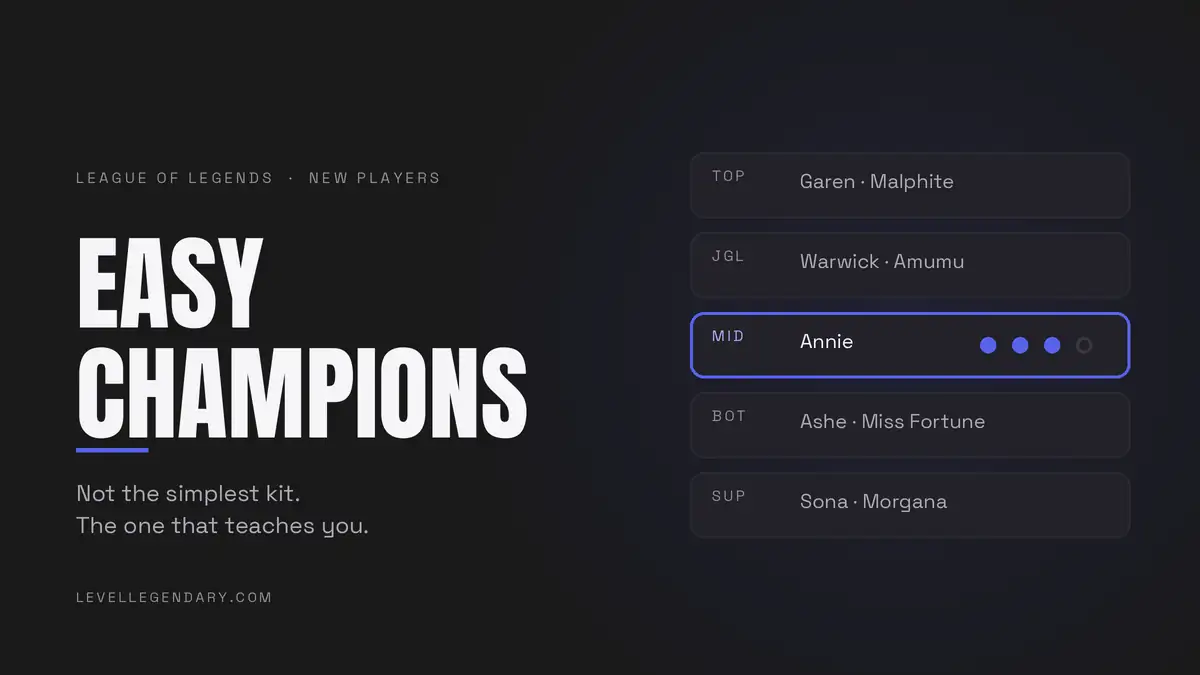
Top lane. Garen has no resource to manage, which removes an entire layer of decisions while you learn trading patterns. Malphite is the other good answer: his ultimate is point and click, and using it well is a lesson in timing rather than aiming.
Jungle. Warwick clears safely, heals himself, and survives the mistakes every new jungler makes on their first clear. Amumu is the alternative if you want to learn teamfighting, because his ultimate rewards patience and punishes walking in first.
Mid lane. Annie, and it is not close. More on why below.
Bot lane. Miss Fortune and Ashe both give you range and a slow, which means you can practise standing in the right place without needing quick hands to survive being caught. Ashe’s slow in particular makes her hits feel deserved rather than lucky.
Support. Sona has no mechanical requirement beyond positioning, so it is pure practice at being in the right place. Morgana is the step up: one skillshot that matters, and a shield that teaches you to watch what the enemy is about to do rather than what they just did.
Why Annie is the best first champion in the game
Annie is the clearest example of every principle above, so it is worth walking through what a game on her actually teaches.
The stun that always lands
Her stun is not a skillshot. It arrives when you press it. Every fight you take gives you honest feedback: you either engaged at a good moment or you did not, and no part of the answer is about your aim.
The counter above her head
Four abilities and your next one stuns, and that counter sitting above your health bar is the most useful piece of teaching in any beginner champion. It makes the abstract idea of a window into something visible.
You look down, you see the stun is ready, and you understand that right now you are stronger than the enemy laner and in ten seconds you will not be. That is exactly the thought a good player has about dragon timers, about summoner cooldowns, and about the level 6 power spike, and Annie puts it on screen where you cannot miss it.
Level 6, all at once
Put the two together. You have the stun stacked, your ultimate up, and the wave is pushing towards you. A beginner on Annie learns to hold that stun rather than spend it on a minion, wait for the enemy mid laner to step forward for a last hit, and then use everything at once.
The kill is not the lesson. The lesson is that they waited for a moment they could see coming, which is the same discipline behind knowing when to leave lane and when an objective is worth contesting.
A player who learns that on Annie can take it to any champion afterwards. A player who starts on a champion with four skillshots usually learns their hands first and the windows much later, if at all.
But easy champions stop working later
This is the objection everyone hears in their first month, usually from someone in their second, and it is mostly false. Annie, Garen, Malphite, Ashe and Morgana are all played at every rank in the game. They are not training wheels. They are champions with lower mechanical ceilings and perfectly normal decision ceilings.
The half that is true is narrower: a simple champion will not carry a bad game by itself. If you want to take over a match with raw mechanics, you eventually need a champion that allows it. But that is a problem for a player who already reads the map, and you do not get to be that player by starting on a champion that hides your mistakes from you.
The version of this advice that ruins accounts is switching every time a champion feels limiting. Twenty games is the minimum before you know whether the champion or the player was the problem.
From the coach
I am known for a champion I would never hand a new player, and that is rather the point. LeBlanc rewards knowing exactly when to commit, and I learned that timing on champions where pressing the button was never the hard part.
Pump The Menace, Challenger, mid lane coach at Level Legendary. See his coach profile.
What to do in your first twenty games
- Pick one champion from the list above, in one role, and do not change either for twenty games. Play them until the kit is boring, because boring is the goal: it means your attention is free for the map.
- Watch one thing only. Not your creep score, not your kill participation. Watch for the moment you become stronger than the person in front of you, and notice what you do with it.
Almost everything else in this game is a variation on that question, and it is the reason a simple champion is the fastest way into a complicated one.
Once you have picked your champion, 1-on-1 LoL coaching is the shortcut past the habits beginners usually spend a season unlearning.
If you would rather have someone show you those windows in your own games than find them by trial and error, your first session is free: a coach reads your OP.GG and goes through one of your games with you, live, with no card required.